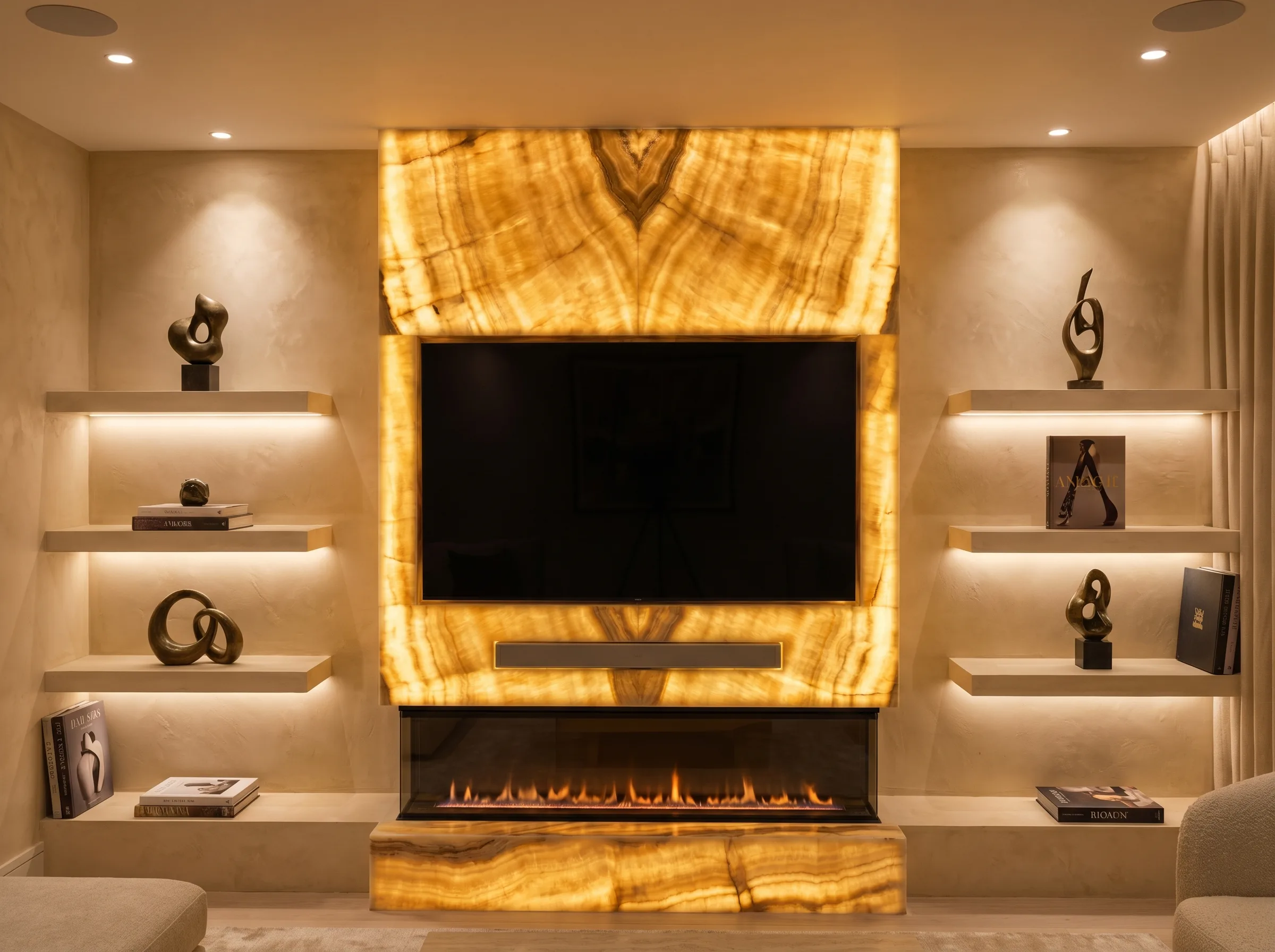
The first question almost every client asks is what a media wall costs. It is the right question and it is also the hardest one to answer in a sentence, because the honest reply is another question: what do you actually want?
That sounds like a dodge. It is not. Nothing we build comes out of a box, so there is no list price to read off. Our media walls start at £7,000 and most land between £10,000 and £18,000, but the reason that range is so wide is worth understanding before you speak to anyone.
We should be straight about something else too. The wall people describe to us usually costs more than they were expecting, and it is almost always because the amount of work involved is invisible in a photograph. Further down this page are three builds we have finished, with what each one came to and what was in it. That is the most honest answer to the question we can give.
Why media walls look cheaper online than they are
There is a lot of content out there showing media walls at prices that seem impossible next to ours. Most of it is a different product wearing the same name. Those units arrive flat packed in a box. They are frequently plastic or foil-wrapped board, made to fixed sizes, in fixed colours, with a fixed fire aperture.
Nothing about them is bespoke, and that is the whole difference. When you buy from a box you accept the measurements you are given. You accept the material, the colour and the layout. You are picking from a catalogue. So if your room has an awkward chimney breast, an unusual alcove width, or you want a corner unit, a boxed product simply cannot do it. It is not that it costs more to adapt. It cannot be adapted.
What bespoke actually means here
We buy the timber. Our hardwood is imported, much of it from Zimbabwe and Botswana, and the wall is built to your specification rather than adapted towards it. If you want shelves at a particular thickness, that is what gets made. If you want lighting concealed inside the shelf, it goes inside the shelf. If you want that light to be a soft pink rather than a warm white, it will be.
The same applies to the details people assume are fixed. Brass handles, sliding doors, Shaker doors on the base cabinets: all of it is a choice rather than an option list. That freedom is the product. It is also, unavoidably, the cost.
The decisions that move the price
The order matters here. Luca, our co-founder and installation director, comes to the house first. He measures properly, checks what the wall and the structure will actually allow, and brings material samples in the finishes you are considering so you can handle them rather than judge them from a screen.
Only after that do we get on a call together, and this is the part clients tend to remember. Daniel builds your wall as a 3D model in SketchUp while you talk, drawing it in front of you. You describe a deeper shelf and you watch it get deeper. You change your mind about the cabinet and it changes on the screen. That model is then rendered and sent to you, and only once you have seen it do we put a price to the job. It is a far faster way to find out what you actually want than a fortnight of emails, and it means nobody is guessing when the quote is written.
These are the questions that get answered on that call, and each answer moves the number.
- The shelving
Floating or recessed? Panelled around the outside, or a clean geometric straight edge? If it is geometric, how do you want the boxes to read: six inches deep or twelve, six inches high or twelve? Each of those is a different quantity of material and a different amount of bench time.
- The cabinetry
Floor standing, floating, or pull out. A floating base cabinet needs concealed structural support behind the plasterboard, which is more work than one that sits on the floor, and it is the detail that makes a wall look like it grew out of the room.
- The material
This is the biggest single lever. Painted MDF is the entry point. Timber veneer sits above it. Mahogany, teak, real porcelain and onyx sit well above that. The wall at the top of this page is backlit onyx, and the material alone puts it in a different bracket to a painted build of identical dimensions.
- The fire
The second biggest lever. A FireFX Atmos starts around £695 including VAT. An Onyx Avanti 150 is around £2,925 and the 190 around £3,465. A Gazco eStudio, which the joinery is built around for a tighter reveal, starts around £1,730. Same wall, different fire, thousands of pounds apart.
- The extras
We have built integrated aquariums, hidden compartments and mini bars into media walls. We have built around hundred inch screens. None of that is unusual for us, but all of it is additional design, structure and services, and it prices accordingly.
The closest comparison is specifying a walk-in wardrobe. There are a million variations and no two quotes are alike, because no two briefs are. Asking what a media wall costs without describing it is a little like asking what a kitchen costs.
If you are weighing up a marble-inspired finish, our marble vs Venetian plaster comparison explains how slab selection, preparation and hand-created veining affect the cost of the finished wall.
Three real builds, and what they came to
Ranges are only so useful. These are three walls we have actually finished, with the specification and the final figure for each.
This client arrived with a handful of Instagram references. She wanted fully bespoke floating cabinets on either side, a floating cabinet along the bottom, and acoustic panels across the wall. No fireplace, no Venetian plaster, no marble. Worth noting what this is not: it is not a stripped-back or entry-level build. It is a fully bespoke one where the money went into joinery rather than into materials.
Helen wanted everything on. Recessed geometric shelving down the left-hand side with oak set inside it, a suede finish running across the whole face of the media wall, and a horizontal fireplace at the bottom. Three of the bigger levers pulled at once: the recessed geometry, the specialist finish and the fire.
Claire had a hundred inch television. Recessed cabinetry either side, a floating cabinet along the bottom, and a hidden compartment for the Sky remote and the clutter that usually ends up on a coffee table. At the base of the shelving on both sides, open cabinets finished with fluted Shaker doors and brass handles. We moved the electrics, did the carpentry, the plastering and everything in between. She left us a great review, arrived with a box of Italian chocolates, and the room was later published in a local magazine.
Look at the last two together, because they explain this better than any price list could. Claire's wall had no fireplace at all and still came in £2,500 above Helen's, which had one. A fire is one of the biggest single costs in a media wall, and its absence did not make the cheaper wall. The screen size, the hidden compartment, the fluted doors and the sheer quantity of bespoke cabinetry outweighed it.
That is why we keep answering the cost question with a question. Two walls of similar size, in similar rooms, £2,500 apart, and the more expensive one has less in it by the usual measure.
How much do carpenters charge for a media wall?
Less than us, usually, and it is worth knowing why before you set the two numbers side by side. A carpenter quoting joinery is quoting a different job. Ours starts at £7,000, most builds land somewhere between £10,000 and £18,000, and that price is the finished room rather than the cabinetry sitting in it.
We sit at the mid to high end of the market and we are direct about that. A meaningful part of the reason is not the joinery at all. It is that you do not have to hire anybody else.
Most media wall companies quote for joinery and nothing more. That leaves you finding an electrician to move the sockets, someone to build the stud work, a plasterer to finish it, and a stone fitter if there is stone. Four trades to book, four quotes to compare, four sets of dates that have to line up, and any gap between them is your problem. We carry all of it in house. We move the sockets, build the studwork, plaster it, fit the stone, and hand you the remote at the end. You turn on the television and the fire, and that is the job finished.
How much would a plasterer charge for a media wall?
Nothing, if we are building it. We do the plastering ourselves so it sits inside the one quote and you are not chasing a second trade for dates that line up. On a joinery-only build the plasterer is someone you book and pay yourself.
What plastering really costs you is time, and it is the one part of the job nobody can hurry. The stud work goes up, we plaster it, and then it needs two or three days to dry before anything can go on top. So we work the rest of the build around it. While that is drying in your living room, your cabinetry is being made and sprayed at our warehouse.
Does a media wall add value to a house?
No, and we would rather say so now than have you work it out afterwards. A media wall is fitted furniture. An estate agent will treat it much as they would a fitted cabinet, and it is not going to change what your house is valued at.
Which is worth knowing before you spend five figures. Build one for what it does to the room you sit in every night. If the sale is the reason, spend the money on something else.
So what should you budget?
If you want a working figure before you speak to anyone: £7,000 is where a bespoke build starts. Between £10,000 and £18,000 covers most of what we do, including the fire, the finish, the electrics and the making good. Above that you are into stone, aquariums and full-wall builds where the joinery runs the length of the room.
The most useful thing you can do is tell us your number at the start. We would far rather design to a real budget than produce a quote that was never going to work. Every quote is fixed price before work begins. If you are planning a media wall across Surrey, Hertfordshire, Buckinghamshire or London, book a consultation and we will give you a real number for your room.
Common questions
Our bespoke media walls start at £7,000 and most projects land between £10,000 and £18,000. The spread is wide because nothing is standard: the same wall in veneer, in painted MDF or in backlit onyx is three different numbers. Above £18,000 you are usually into stone, integrated aquariums or full-wall builds with bar and storage joinery built in.
Three we have finished recently. Just under £8,000 for fully bespoke floating cabinetry both sides with acoustic panelling and no fire. £11,000 for recessed geometric shelving in oak, a suede finish across the whole wall and a horizontal fireplace. £13,500 for a hundred inch screen with recessed cabinetry, a hidden remote compartment and fluted Shaker doors with brass handles, and that one had no fireplace at all. The most expensive of the three had the least conventional specification, which is the clearest answer to why there is no price list.
Most of the cheap media walls advertised online arrive flat packed in a box. They are made to fixed sizes in fixed colours, often in plastic or foil-wrapped board, and you choose from a catalogue. We buy the timber, including hardwood imported from Zimbabwe and Botswana, and build to your room. If your alcove is an unusual width or you want a corner unit, a boxed product physically cannot do it.
Material, then fire. Painted MDF is the entry point, timber veneer sits above it, and real stone, porcelain or onyx sits well above that. The fire is the next biggest swing: a FireFX Atmos starts around £695 including VAT, while an Onyx Avanti 190 is around £3,465. Those two decisions alone can move a quote by several thousand pounds before any joinery changes.
No, and this is a large part of why we sit where we do on price. Most media wall companies quote joinery only, which means you still need trades to move sockets, build stud work, plaster and fit stone. We carry all of it. We move the sockets, build the studwork, plaster, fit the stone, then hand you the remote at the end. One quote, one team, one finish date.
Yes, and it is the conversation we would rather have first. Tell us the number early and we will design to it, being straight about what it does and does not buy. A budget spent on a simpler shelf design in a better material almost always looks more expensive than the reverse. Because Daniel models the wall in SketchUp with you on the call, you can see the effect of a change while you are still deciding rather than after the quote lands. Every quote is fixed price before work begins, so the figure you agree is the figure you pay.