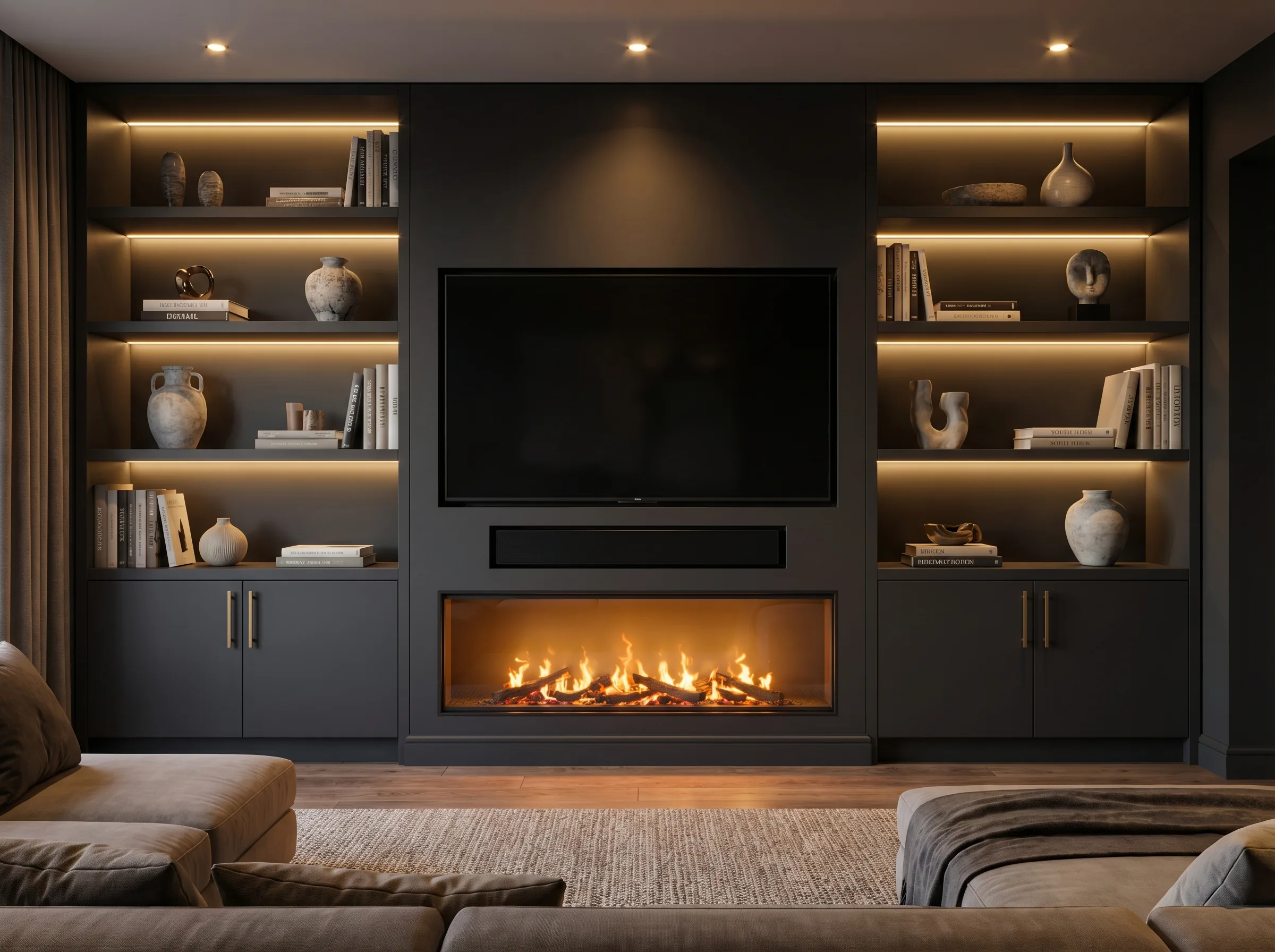
The fireplace is the most consequential specification decision in any media wall build. Get the size wrong and it looks like an afterthought beneath the television. Get the type wrong and you are living with the consequences for years. Here is how we think about the choice.
Fire Type: Electric, Bio-Ethanol or Gas
The first decision is the fuel type, and it is largely determined by what is available in the room rather than personal preference.
Electric fires are by far the most common choice for media walls, and for good reason. They require no flue, no gas supply and no structural works beyond a standard electrical connection. They are the simplest to install, the safest in enclosed joinery builds, and modern cassette-style electric fires produce a convincing flame effect at a wide range of sizes. They are the default recommendation for any media wall project.
Bio-ethanol fires produce a real flame without a flue, which some clients prefer for authenticity. The trade-off is ventilation: a bio-ethanol fire in a joinery enclosure requires considered airflow design to prevent heat build-up. They also require refuelling and produce a small amount of water vapour. We install them regularly, but they require more careful detailing.
Gas fires are less common in media wall builds because they require a gas supply to the wall position and a flue, which in many living rooms means structural work. In properties where a chimney breast already exists and the gas supply is present, a gas fire can be the right choice. Otherwise, electric is simpler and the visual result is comparable.
Fire Width: Size It to the Television, Not the Wall
This is the dimension most people get wrong. The instinct is to size the fire to the cabinet it sits in, or to whatever the supplier happens to have in stock. That produces a fire out of proportion with the screen above it, which leaves both looking unresolved.
The proportion that reads well in most rooms is a fire at 90 to 115 percent of the television width. For a 65" screen (144cm wide), that suggests a fire in the 130 to 165cm range. For a 75" screen (167cm wide), we typically specify between 150 and 190cm. The fire should read as a full-width band beneath the screen rather than an insert shrinking below it.
A narrow fire on a wide screen, say a 60cm insert beneath a 75" television, looks like a pilot light. It draws the eye down to the wrong place and makes the overall composition feel unbalanced. Width is the dimension that matters most.
Flame Depth and Heat Output
Electric fires vary significantly in the depth of flame effect they produce. Budget cassette fires produce a flat, two-dimensional flame that reads as obviously artificial at close range. Better fires use multiple flame layers, typically three or four, to produce a convincing depth. At 2 to 3 metres viewing distance, a three-layer flame effect is difficult to distinguish from real fire.
Heat output matters less than most people assume. An electric fire in a media wall is primarily decorative in most homes. The room is already heated by the central heating system. We typically recommend fires with at least 1.5kW output as a minimum, but the flame quality is a more important spec than the kilowatt rating.
The Fires We Fit
We are not tied to one manufacturer. A small number of ranges cover most of what we build, and between them they handle nearly every brief that comes through the door. All are electric, all are made for exactly this kind of joinery, and all come in the widths that actually match a television rather than the widths a fireplace showroom happens to stock.
FireFX Atmos is the range we reach for most often. It slots straight into the joinery with an integrated frame, and at 140mm deep it needs very little wall behind it, which matters when you are building against a solid wall rather than into a stud. Four widths: the 105R at 1050mm, the 135R at 1350mm, the 165R at 1650mm and the 195R at 1950mm. Prices start at around £695 for the 105R and run to about £995 for the 195R, including VAT.
Onyx Avanti is the other range we specify regularly. It comes in three widths, the 110, the 150 and the 190, and we fit the 150 and the 190. Onyx put the 150 against a 50 to 65 inch screen and the 190 against a 65 to 75 inch, which lines up with the sizing rule above rather than fighting it. From around £2,925 for the 150 and £3,465 for the 190. It is the most expensive range here, and it is what went into a recent Essex build with a 75 inch screen, where the fire needed to read wider than the television above it.
Gazco eStudio is a build-around rather than a slot-in: the joinery is constructed around the fire rather than the fire dropped into a hole. That gives a tighter, more resolved reveal where the fire meets the panel, which is worth paying for on a wall you are going to look at every night. It comes in five widths from the 60R up to the 165R, with the 135R measuring 1348mm. Expect from around £1,730 for the 135R.
Sizing follows the rule above rather than the price list. On a 65" screen we would specify a 135R or a 165R from either range. On a 75" screen it is a 165R, the Atmos 195R, or the Avanti 190 where the wall is wide enough to carry it. If a fire is being specified for you at 105R against a 75" television, ask why.
A Recent Project: Sizing the Fire to the Screen
A client in a Home Counties detached home wanted a media wall with a 75" television and an integrated fire. The room had no gas supply and a chimney breast that had been removed in a previous renovation, leaving a flat wall.
We specified a 165cm wide-format linear electric cassette fire. At 165cm against a 167cm screen, the ratio is 99 percent, so the fire reads as a full-width band beneath the television rather than an insert floating below it. The fire sits in a recessed stone panel below the television, framed by cabinetry on each side.
The original brief included a 90cm fire from a shortlisted product. We advised against it. At 54 percent of the screen width, it would have drawn the eye but in the wrong way. The mismatch between screen and fire would have been noticeable every time someone sat in the room. The 165cm fire cost more, but the proportional result was worth it.
Summary: What to Specify
- Type: electric unless you have a specific reason for bio-ethanol or gas
- Width: 90 to 115 percent of your television width
- Flame depth: three-layer minimum for a convincing effect
- Heat output: 1.5kW minimum, but treat heat as secondary to flame quality
- Install: always within the joinery build, never surface-mounted as an afterthought
Common questions
Size the fire to the television, not to the cabinet it sits in. The proportion that reads well in most rooms is a fire at 90 to 115 percent of the television width. For a 65 inch screen, which is 144cm wide, that means a fire of roughly 130 to 165cm, so a 135R or a 165R. For a 75 inch screen at 167cm wide, we typically specify between 150 and 190cm.
Electric is the default recommendation for most media walls. It needs no flue, no gas supply and no structural work beyond a standard electrical connection, and it is the safest option inside enclosed joinery. Bio-ethanol gives you a real flame without a flue, but it needs considered airflow design to prevent heat build-up, plus refuelling, and it produces a small amount of water vapour.
Less than most people assume. An electric fire in a media wall is primarily decorative because the room is already heated by the central heating system. We recommend at least 1.5kW as a minimum, but flame quality is the more important specification. Look for multiple flame layers, typically three or four, which is what makes the effect convincing at a normal viewing distance of 2 to 3 metres.
Yes. This is the most common situation we build for. An electric fire needs only a standard electrical connection, so no gas supply, flue or chimney breast is required. Bio-ethanol also runs without a flue. Gas is the option that needs both a supply to the wall position and a flue, which in most living rooms means structural work.