Media Wall Storage: What Should Be Open, Closed or Hidden?
Nearly everyone who asks us for a media wall wants storage somewhere in it. Before we draw anything, I want to know what will actually go there. Which pieces do you want on show, and which things would you rather hide away?
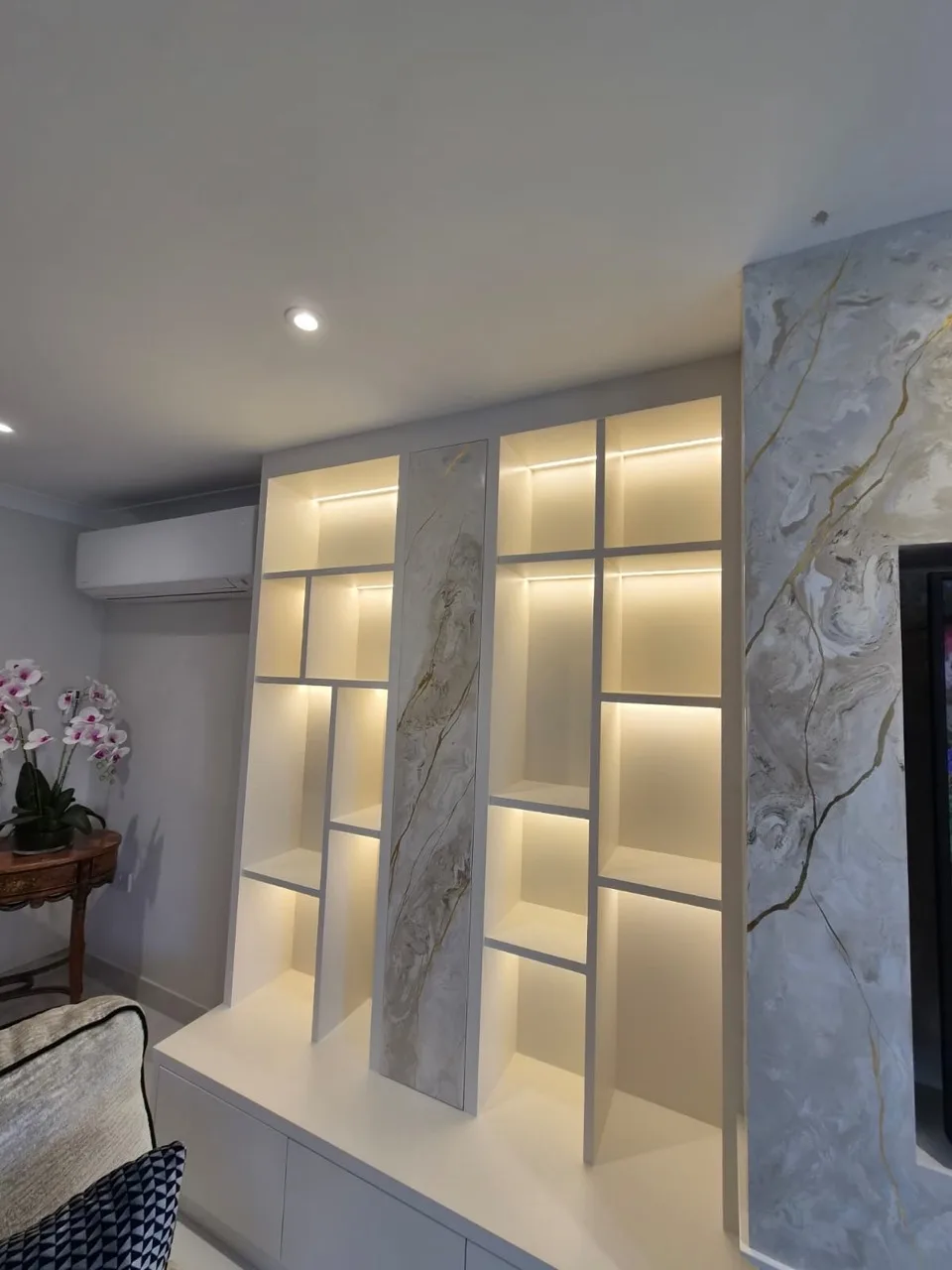
What are you actually going to put there?
People often ask for storage without knowing exactly what they will put in it. That is why we ask about the objects first. Family photographs, plants, vases and ornaments all need different amounts of space. A games console needs ventilation and cable access. Blankets need a deep drawer.
If you have a particular photograph, sculpture or ornament in mind, measure it before we finalise the drawing. One large piece can change the width of a column or the height of several shelves. It is much better to find that out on the drawing than after the cabinet has been built.
A media wall with shelves works for the things you enjoy looking at. A media wall with cupboards hides the everyday things you still need in the room.
A photograph that changed the whole cabinet
A client in North London had a school photograph of her daughter. It was not a normal class photograph. It showed around 180 pupils, so the frame was unusually wide.
She wanted it displayed within the media wall, but the room was tight. We could not keep both shelving columns the same width and still fit the frame. I normally prefer the two sides to match, but forcing symmetry here would have meant leaving out the photograph she cared about.
So we made the left shelving column wider than the right. It is not something I would usually suggest, but once the other shelf divisions were adjusted it looked right. More importantly, the photograph fitted properly.
This is why we ask what will sit on the shelves. Sometimes one object changes the whole cabinet, and that is fine. The cabinet should be built around the client, not the other way round.
Upper shelves should feel like a display, not a kitchen
About 95% of our clients prefer open shelves at the top of a media wall. I agree with them. Doors above the television can start to make the wall look like a kitchen. Open shelves are better for photographs, plants and ornaments.
I also prefer the shelves to be illuminated, even if the lighting is discreet. Most project photographs are taken during the day, so people do not always see how good the wall looks at night. When the television is on and the room lights are down, the shelf lighting makes a big difference. The LED strip itself should stay hidden. You want the glow, not a row of bright dots.
The downside is dust. Open shelves need more cleaning than cupboards. Dark brown, grey and black finishes show dust quickly, particularly when the LEDs are on. They need a wipe every week to keep them looking fresh. Pale plaster and painted shelves are a little more forgiving.
Why drawers are usually the most useful option
If there is no fireplace, my favourite option is a floating run of deep drawers beneath the television. I normally suggest at least four. They give you a lot of storage without making the wall look heavy.
Clients put blankets, dog treats, controllers, chargers and all sorts in them. Basically, the things that would otherwise sit on the sofa or coffee table. We fit soft-close runners to every drawer, so nothing needs to be slammed.
The depth depends on the room and what sits behind the cabinet. We work it out alongside the sockets, cables and television bracket. If you decide it after the front design has been approved, it is usually too late.
- Useful storage at a height everyone can reach
- Flat fronts keep the television wall visually quiet
- Soft-close runners protect the joinery
- Internal divisions can separate remotes, cables and larger items
Why we rarely combine lower storage and a fireplace
A soundbar, lower cabinetry and a fireplace all need roughly the same space beneath the television. Any one of them can look good. Put all three together and you end up stacking cabinet, fire, soundbar and television. In my opinion, it looks crowded and cheapens the whole wall.
You can put drawers at the bottom and raise the fireplace above them, but then the soundbar and television also have to move up. The television often ends up too high and there is simply too much happening in one area.
I would choose one or the other. If you need the storage, use deep drawers along the bottom. If the fireplace is the main reason for the project, give it enough space and put any storage in the side columns. Adding more features does not automatically make a media wall better.
Cables, equipment and access behind the television
You also need somewhere for the equipment that makes the media wall work. We can put access panels inside cupboards or behind removable sections so an electrician can still reach the sockets, LED drivers and cable connections after the wall is decorated.
If the wall is deep enough, the television can sit on a pull-out bracket and swing away like a door. We can then fit another concealed compartment behind it. The cables need enough slack to move safely with the bracket, and equipment that gets hot needs ventilation.
You should never have to damage the finish to reach something that may need replacing. If an electrician has to cut through the plaster to change an LED driver, the access was not planned properly.
We sort these details out during the measured design stage. The media wall CAD drawing shows the recesses, cabinet depths, equipment and access points before we build the frame.
| Storage type | Best for | Main advantage | Watch for |
|---|---|---|---|
| Open shelves | Photographs, plants, books and objects you want to see | Easy to reach and visually light | Needs regular dusting |
| Lower drawers | Blankets, remotes, dog supplies and everyday clutter | Deep, useful storage with a clean front | Competes with a fireplace for the same space |
| Closed cupboards | Consoles, routers, games and larger equipment | Keeps the wall calm when the room is in use | Equipment needs ventilation and cable access |
| Concealed panel | Items that should stay out of sight | The storage disappears into the finish | Door movement and finish joints must be planned |
| Behind the television | Occasional-access equipment and compact storage | Uses otherwise wasted depth | Requires a pull-out bracket and managed cables |
Media wall storage FAQs
What is the best storage for a media wall?
Open shelves work best for objects you want to see, while lower drawers and cupboards are better for blankets, remotes, games equipment and everyday clutter. The right answer normally combines display storage above with concealed storage at a comfortable height below.
Can storage be hidden inside a media wall?
Yes. A push-to-open panel can be finished in the same timber, plaster or decorative treatment as the rest of the wall. Storage can also sit behind a television on a pull-out bracket, although access, cable movement and ventilation must be planned before the wall is closed.
Can a media wall have drawers and a fireplace?
It can, but we rarely recommend placing drawers, a fireplace, a soundbar and a television in one vertical stack. The centre becomes crowded and the television is often pushed too high. In most rooms, choosing either useful lower storage or a properly proportioned fireplace produces a cleaner design.
Are open media wall shelves difficult to keep clean?
Open shelves collect more dust than closed cupboards, especially when they are illuminated. Dust is more visible on dark timber and needs regular wiping, while pale plaster and painted finishes are generally more forgiving.
How much does a bespoke media wall with storage cost?
Our bespoke media wall projects start from £7,000. The final price depends on the amount of joinery, drawer hardware, specialist finishes, lighting, hidden mechanisms and the work required for electrics and cable access.