Can you change the TV in a media wall?
Planning for upgrades and repairs
Yes. A replacement TV can often go onto a media wall without changing the joinery. Whether it fits inside the opening, or needs to sit in front of it, depends on how the wall was designed and the television you choose next.
By Daniel, Design Director at LV Carpentry
The question we ask before building
"Is this probably the biggest TV you're going to want?" It's a question we ask at the site survey, because the answer can change the design.
By then, we've discussed the room and a rough guide price. Once the client is comfortable with that figure, we visit to measure the existing wall, the space the media wall will occupy, the panelling and the television.
Most of our clients already know how they want to use the room. Our part is to advise on the proportions of the media wall, TV size, finishes, lighting and access. If a larger screen would suit the proposed wall, we'll discuss it. Clients often decide to buy that TV before we build.
If they want to keep their current television for now, we need to know how much flexibility to leave.
A recess or a TV in front of the panelling?
A close-fitting recess gives the television a defined place within the wall. The opening becomes part of the finished design, so its dimensions matter when you come to replace the screen.
You can make the opening larger from the outset. But there is a trade-off: an opening sized for a future 75-inch TV will leave a noticeably wider gap around the 65-inch TV you own today. You have to be happy looking at that gap until you change it.
If you expect to buy a much bigger TV but haven't decided which one, our advice is usually to mount it in front of the panelling. You still need room between shelving and other features, but you won't have a finished opening dictating the screen size.
If you like the fitted appearance and expect to keep a similar size of TV, a recess may suit you perfectly well.
A little room for a later upgrade
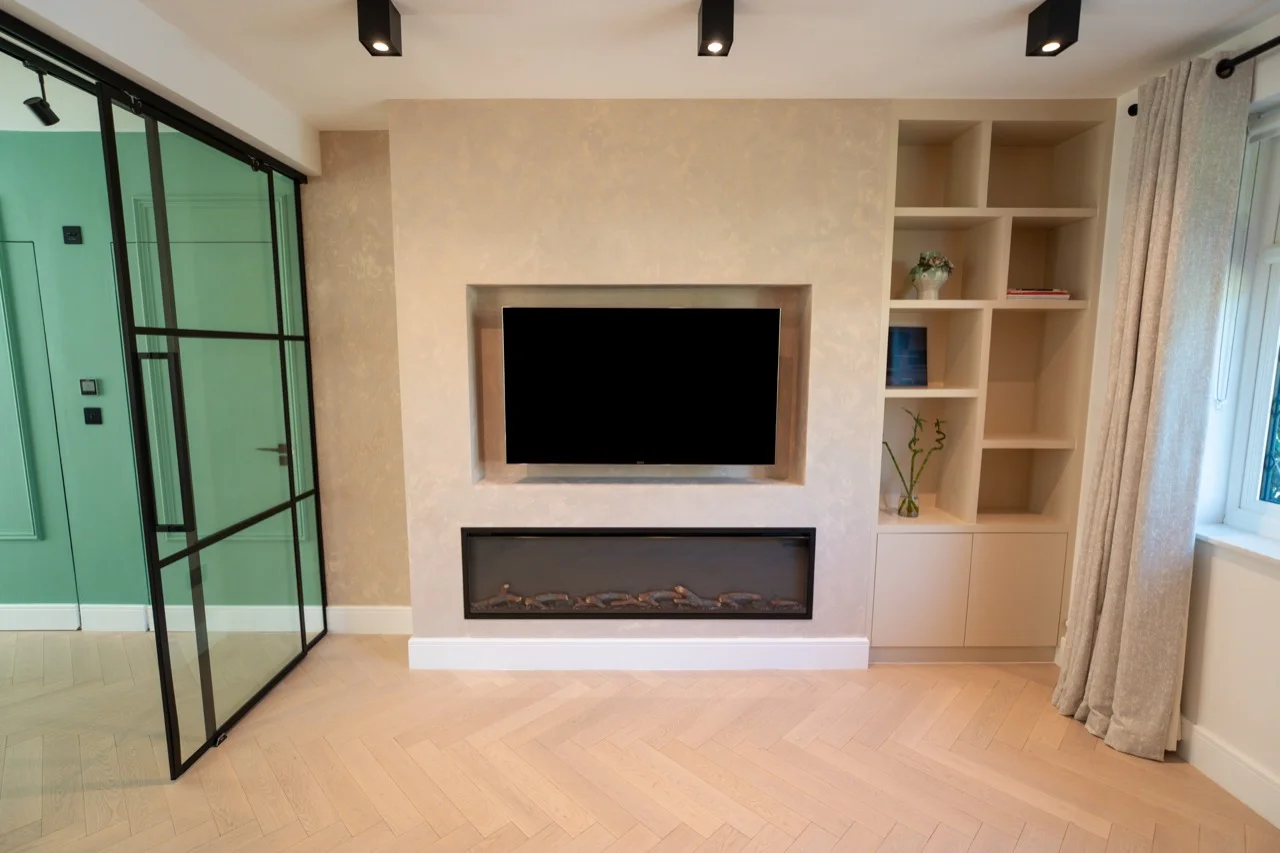
The client on this project told us they might want a slightly larger television later. We left some space around the current screen rather than fitting the opening tightly to its edges.
You can see that allowance in the photograph. It keeps the recessed appearance, with a little room to grow. It wouldn't accommodate any television the client might choose: a replacement would still need checking against the finished opening and the equipment clearances.
Use the actual width, height and depth of the TV for that check. The advertised size is the screen's diagonal, so a change in inches doesn't tell you how much extra space you need on each side.
What if the new TV is bigger than the recess?
It may be possible to bring the bracket forward and position the larger television in front of the opening. The screen can overlap the recess and conceal it when viewed from the front.
That changes the appearance: the TV sits in front of the finished face rather than inside it. Depending on the screen and bracket, the gap behind it may still be visible from the side.
We would check the bracket's reach and load rating, the support behind it, cable clearance and whether the new screen covers the opening. If that arrangement doesn't work, changing the recess remains an option, but it can involve alterations to the framing and making good the finish.
Can you keep the same TV bracket?
Sometimes. Check the replacement model against the bracket's specification before assuming it will fit. The TV's weight, mounting-hole pattern and required screws all matter, as does the support the bracket is fixed to.
The mounting-hole pattern is often described as VESA. Matching that pattern alone isn't the whole check. Sony's model-specific mounting information, for example, lists weights and hole spacing and notes that screw requirements can differ.
With a compatible television and bracket, replacement may leave the joinery untouched. Follow the TV and bracket instructions for removal and fitting, including the handling help the screen needs. If a new bracket is required, check the existing fixing position and support before installing it.
Getting to cables and equipment
On our installations, we plan an access panel behind the TV and a bracket that allows the screen to pull forward. That gives access to the concealed sockets, cabling and lighting power supply. We agree the panel position with the client, including which side will be convenient to reach.
We can also incorporate access into the shelving. Wherever the panel goes, it needs to remain reachable after a TV upgrade, with the screen pulled forward or removed.
Most of our clients stream their television. Where someone does want a disc player, it usually goes into the bespoke unit beneath the screen. Sky boxes and games consoles can also be accommodated, with the compartment designed around the actual device.
We provide openings at the back of units for cables and airflow. The equipment still needs its specified ventilation space: a cable opening on its own doesn't establish that a closed compartment is suitable. Sony's PS5 guidance calls for clear vents and at least 10cm of free space around each side of the console.
A build-out around 250mm deep can provide useful space behind the finish, but that isn't the same as 250mm of usable equipment storage. Our media wall depth guide explains how the construction and chosen equipment affect it.
Can concealed LED lighting be replaced?
Yes. For our TV halo lighting, the strip is hidden behind the television. From the front you see the glow around the screen, rather than the strip itself.
With that accessible arrangement, we'd typically allow about 25 minutes for a straightforward strip replacement. That's an estimate for the strip, not a promise covering fault-finding, a failed power supply or every lighting installation.
The power supply sits in the accessible space behind the TV too. Concealing it should not mean sealing it inside the finished wall. Any work involving fixed mains wiring belongs with a qualified electrician.
For the placement and appearance of the lighting itself, see our media wall lighting guide.
You should know how your media wall works
At handover, we show clients where the access panel is and how to open it. We also explain the lighting controls, including colour adjustment where it has been fitted. These are things you should be able to find and use once we've left.
In our 13 years of doing this, we haven't been asked to return specifically to replace a client's TV. That's our experience, rather than a claim that every future change will be straightforward. We would be happy to arrange a visit if a client wanted help.
Before ordering a replacement, check its full dimensions, the bracket compatibility and how you will reach the connections. If you are commissioning the wall now, tell your installer whether the television you own is the one you expect to keep. That conversation is much easier before the recess is built.