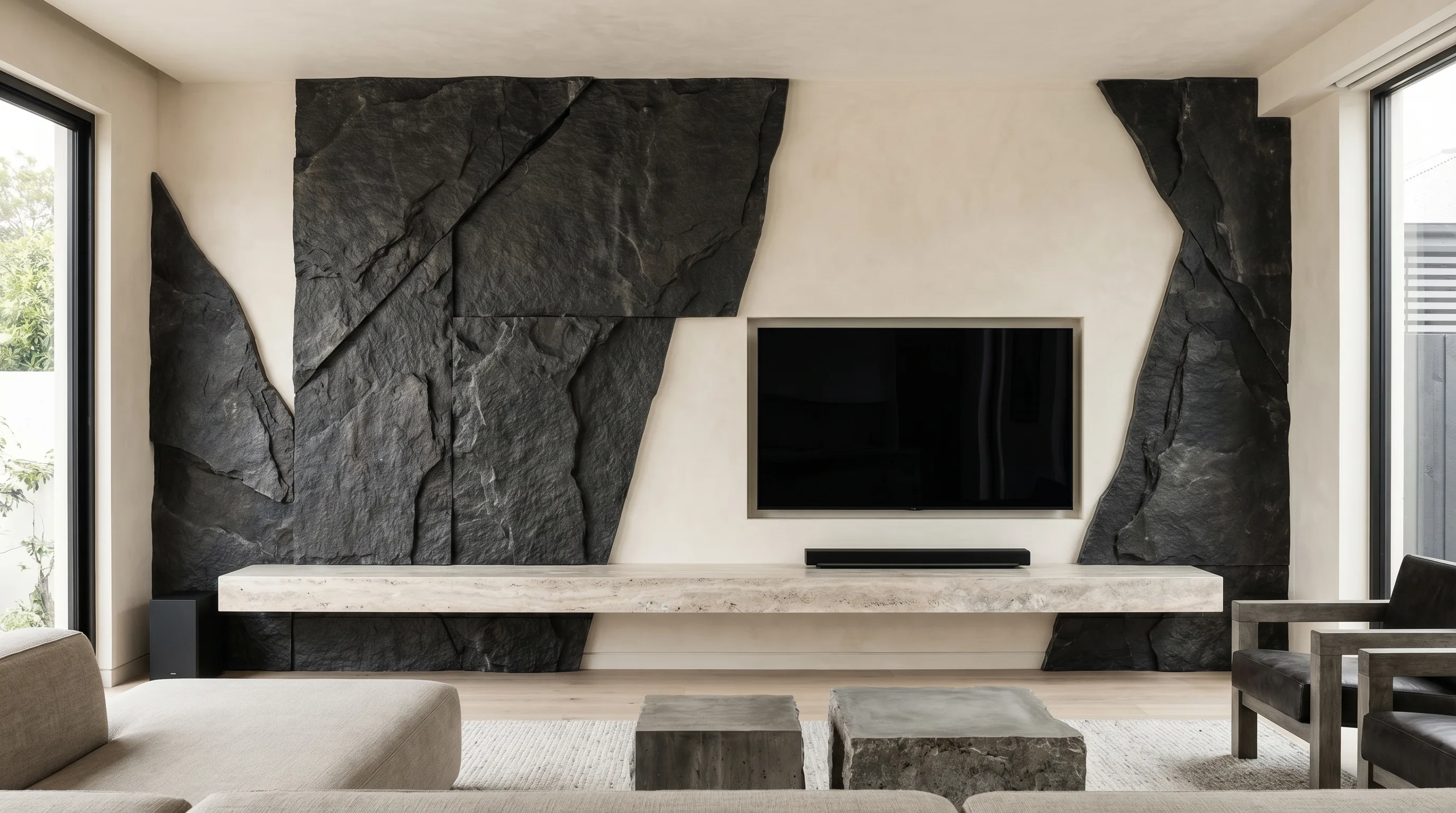
A good media wall is not just a place to hang a screen. It has to resolve storage, cable management, proportions, lighting and surface finish in a way that suits how the room is actually used.
The ideas below are written to show more than style. Each one includes a practical design constraint, a build detail or a technical decision that gives the concept more substance on the page.
Complimentary consultation across London and Surrey. Fixed price before work begins.
Book a Consultation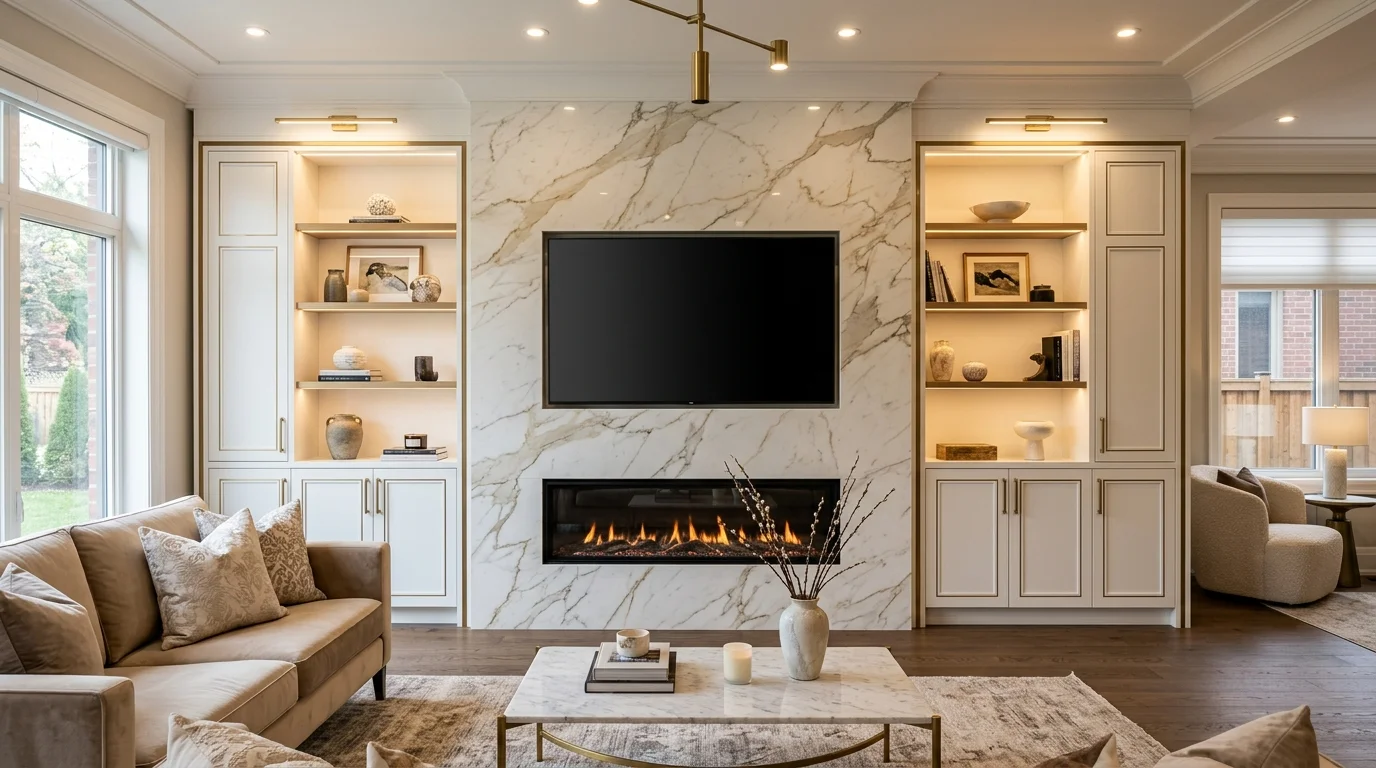
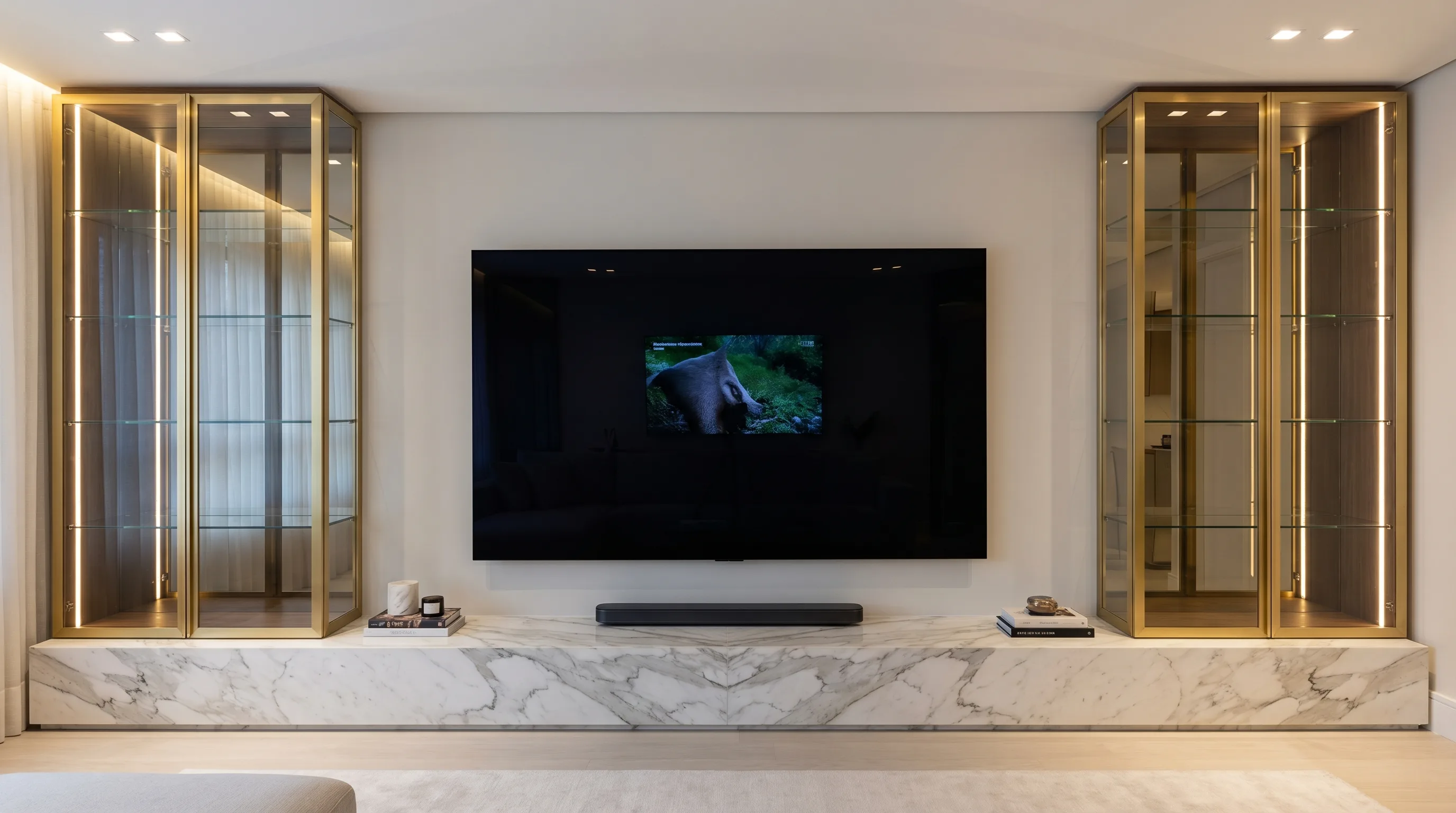
Marble-Effect Statement Media Wall
Calacatta-look porcelain is usually chosen when the wall needs a sharper, more architectural surface than painted MDF can offer. In most layouts, the slab works best on a flat central panel with the television recessed slightly forward so the veining remains visible around it. Keep the main feature wall at least 3 metres wide if you want full-height slab joints to look intentional rather than squeezed. Done properly, the stone effect reads as part of the room architecture rather than decoration added later.
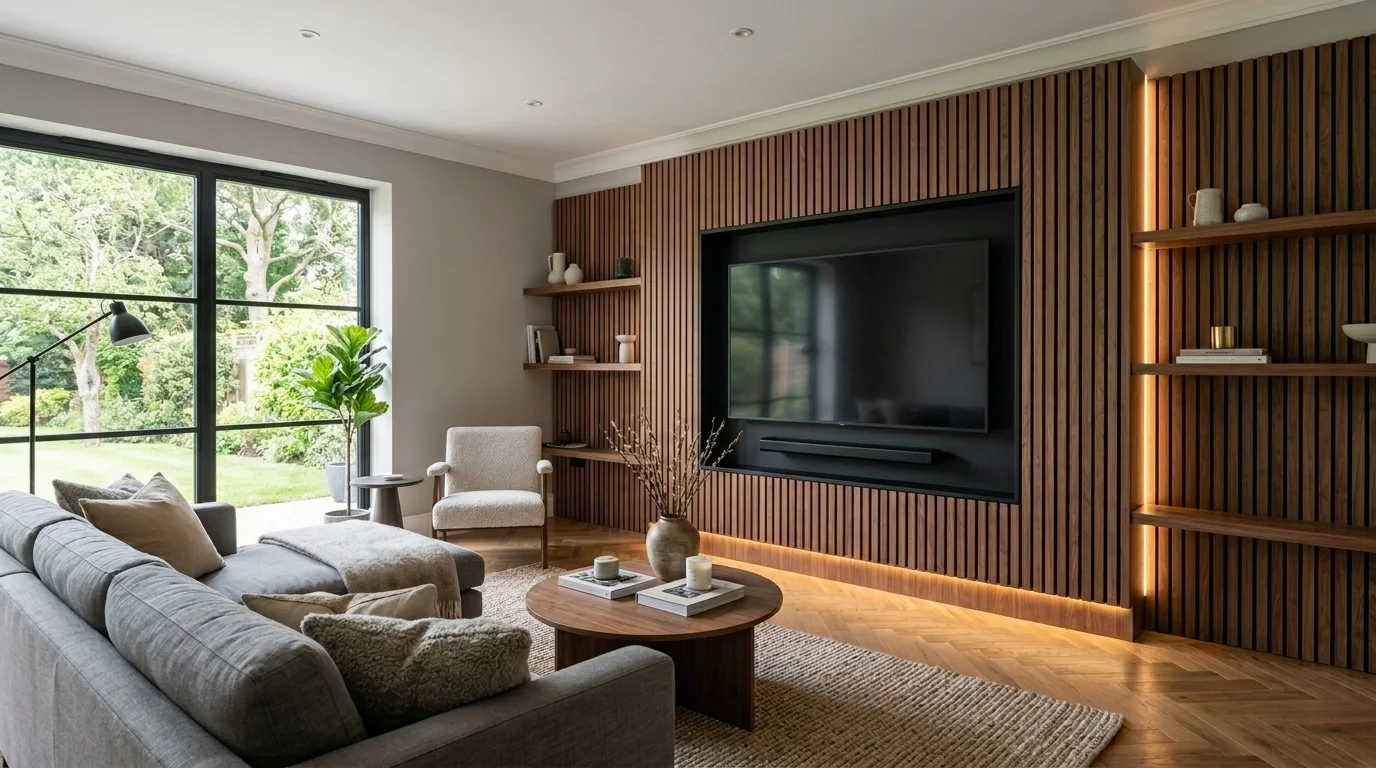
Slatted Wood Media Wall
If the room already has hard flooring, large glazing or a lot of pale plasterwork, timber slats can stop the space from feeling acoustically and visually cold. Walnut veneer is a stronger choice than printed oak-effect boards because the grain variation gives the surface more depth at close range. Leave a consistent 10 to 12 mm shadow gap between slats or the rhythm starts to look uneven once the LEDs are switched on. That small detail matters. It turns a simple wall into something much more controlled.
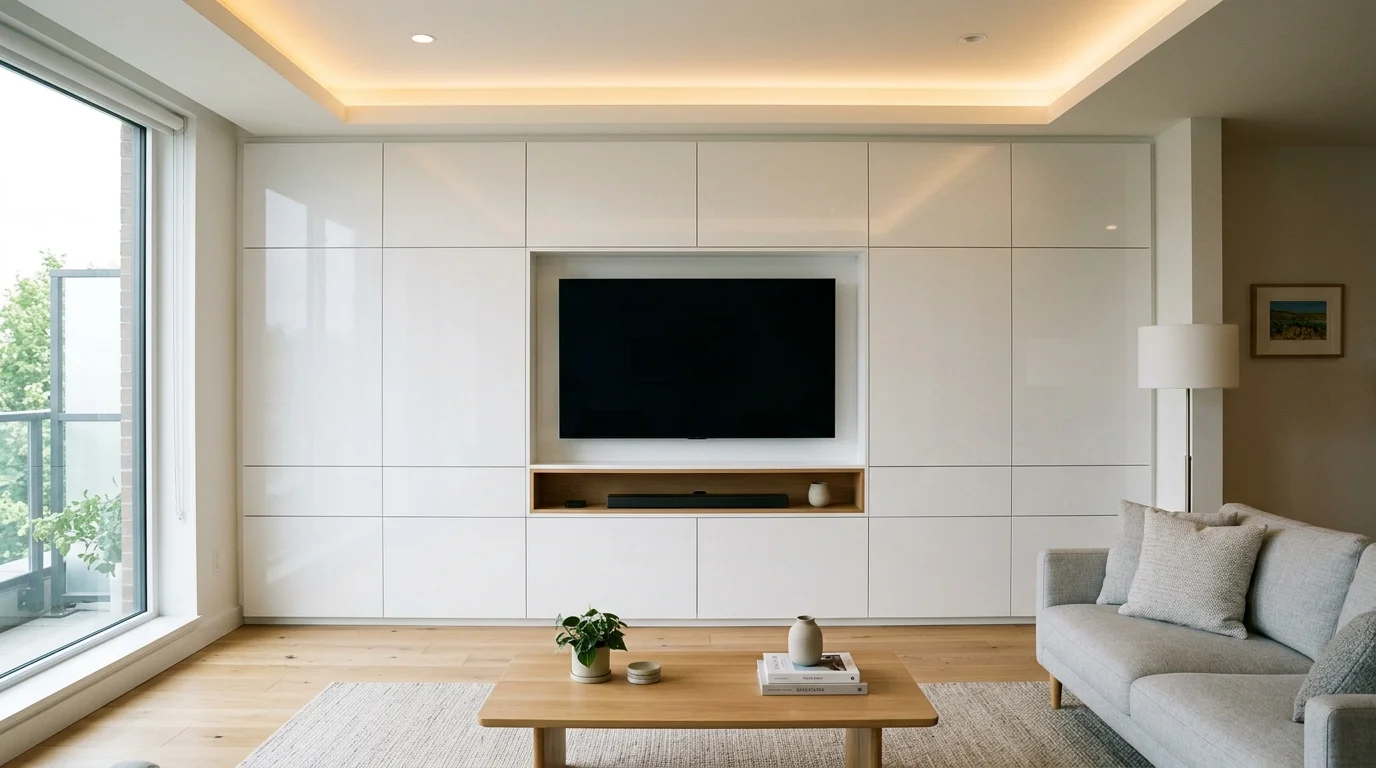
Minimalist Floating Media Wall
This layout is usually the right answer when floor space is limited and the client still wants concealed storage. A floating cabinet run keeps the centre of the room visually open, but it only works if the wall has enough depth for cable routing, sockets and bracket clearance behind the TV. Cashmere matte lacquer suits this style because it keeps light reflection low and fingerprints less obvious than darker gloss finishes. Plan for at least 100 mm internal service void depth. Without it, the "minimal" look disappears the moment boxes and wires need a home.
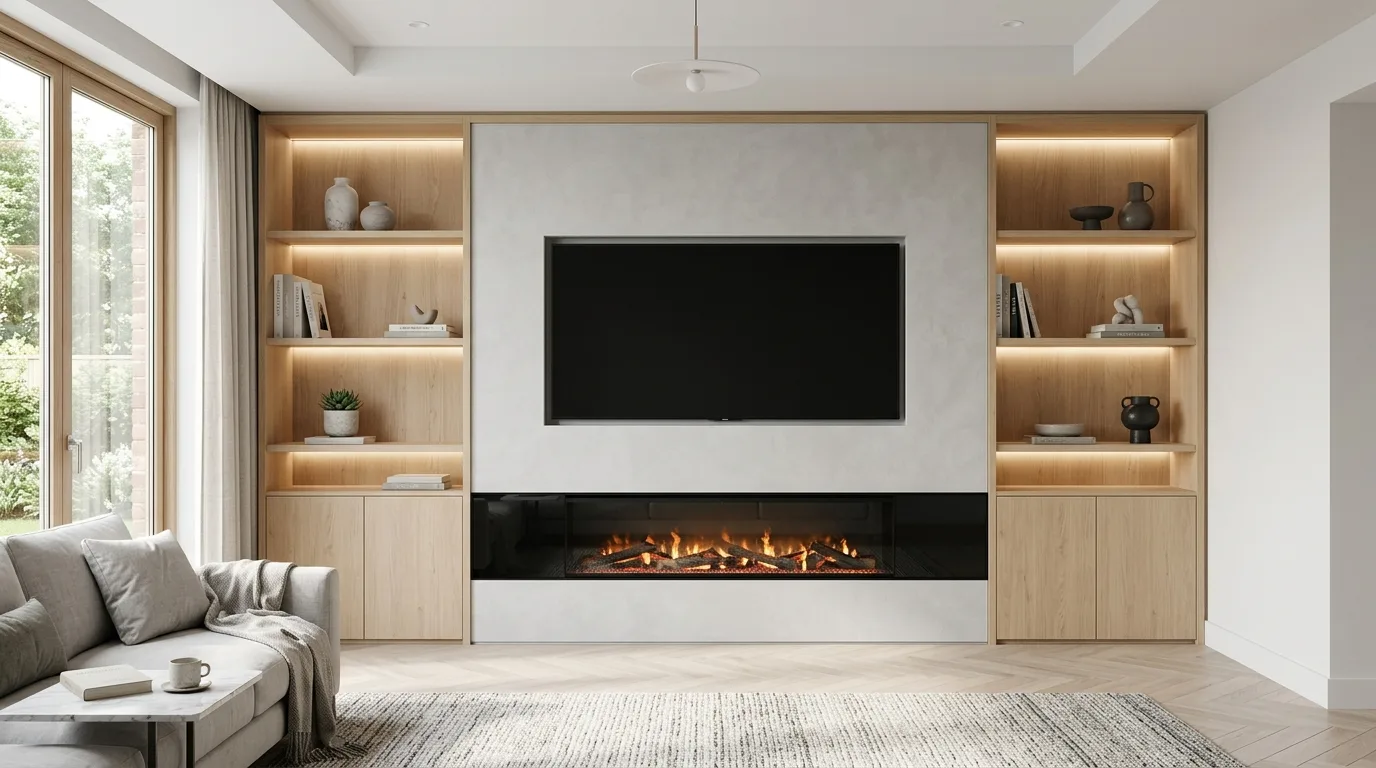
Fireplace Media Wall
A chimney-breast layout often pushes the design in this direction because the room already wants a central composition. Instead of treating the fire as decoration, the better approach is to align the television width, fire opening and lower cabinet breaks so the whole wall reads as one set of proportions. A 1.2 metre electric fire tends to sit comfortably beneath a 65-inch screen without looking too short or too dominant. Heat clearance still needs checking. Even with electric models, the specification sheet should drive the gap above the fire, not guesswork.
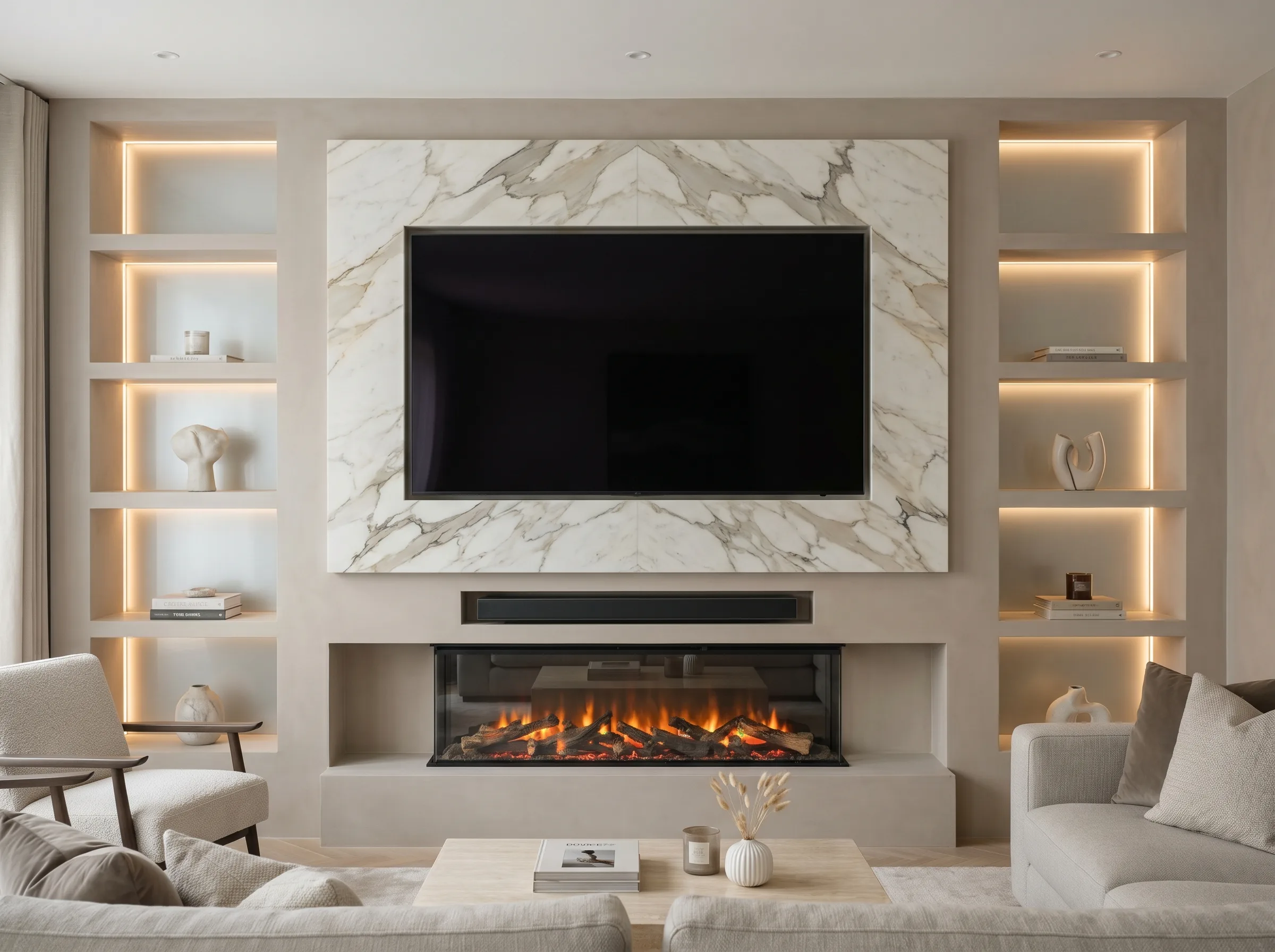
Venetian Plaster Media Wall
Some rooms do not need another timber or stone feature. They need texture. Venetian plaster works especially well in spaces with warm lighting and limited shelving because the finish already carries enough movement on its own. Ask for sample boards first, since the same plaster can look flat in daylight and far more clouded at 2700K evening light levels. That is the whole point of this option. It relies on surface depth rather than joinery complexity.
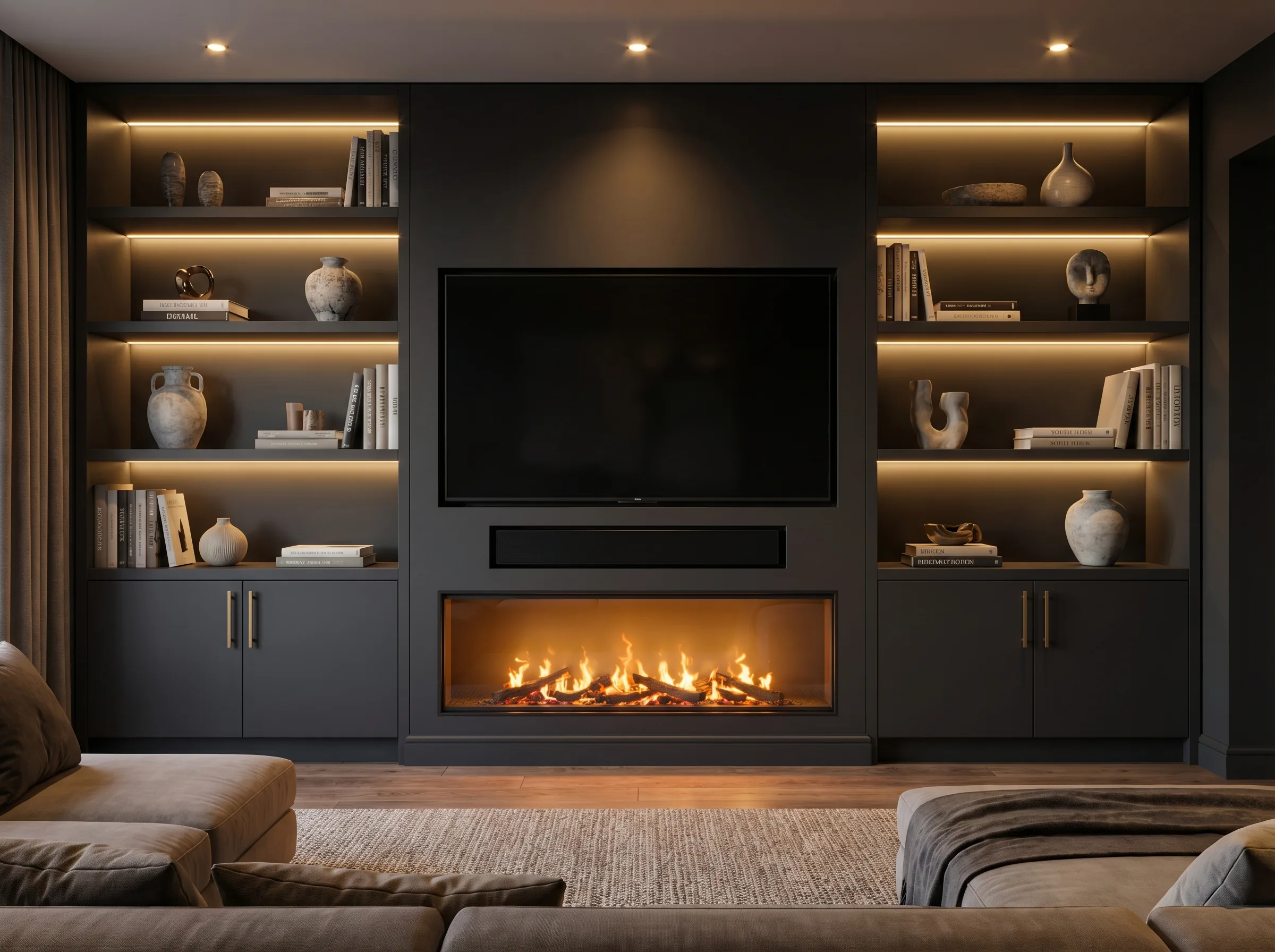
Dark and Moody Media Wall
Large open-plan rooms can look slightly disconnected when every surface is light, especially if the television wall has no visual weight. In that setting, smoked oak, charcoal lacquer and bronze-tinted glass can pull the seating area together without needing extra ornament. Use dimmable LED strips at around 3000K rather than cool white lighting, otherwise the darker materials start to look harsh and grey. The drama comes from contrast. Not from making everything black.
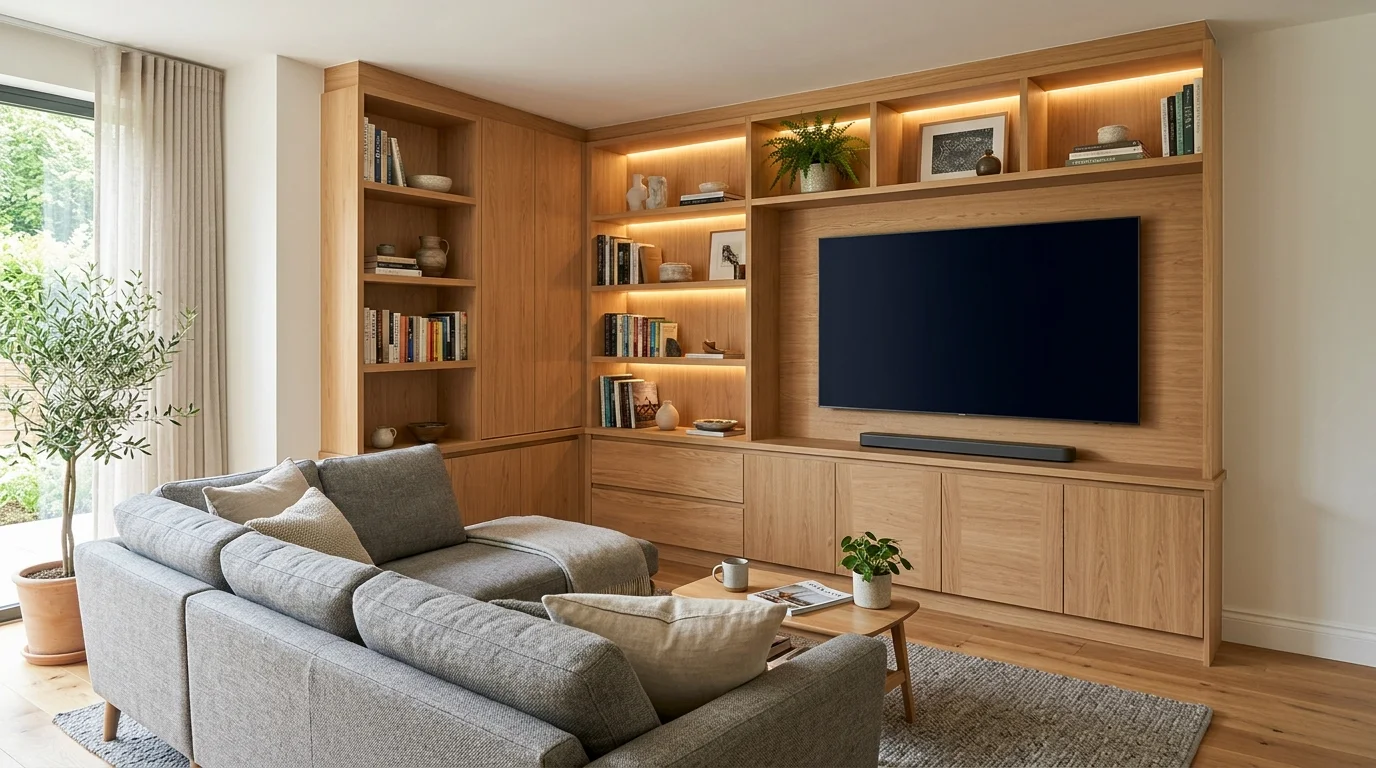
Symmetrical Alcove Media Wall
When a room has a chimney breast with alcoves either side, symmetry solves half the design problem before the joinery even begins. The key is to measure both recesses independently because older walls are often out by 15 to 30 mm, which is enough to make matching cabinetry look wrong if you build from one assumed width. Painted shaker-style doors or flush slab fronts can both work here, depending on how modern the room needs to feel. The success of this layout comes from alignment. Shelves, doors and TV centreline all need to agree.
Soft Neutral Media Wall
In family rooms, the challenge is often how to add storage and a large screen without the wall taking over the whole space. Soft neutral finishes such as stone beige, mushroom and warm taupe make that easier because they sit quietly against most flooring and upholstery palettes. A micro-textured laminate is often more practical than sprayed paint in this kind of scheme, particularly on lower cabinets that will be touched every day. Keep the lighting subtle. Recessed shelf channels are usually enough on their own.
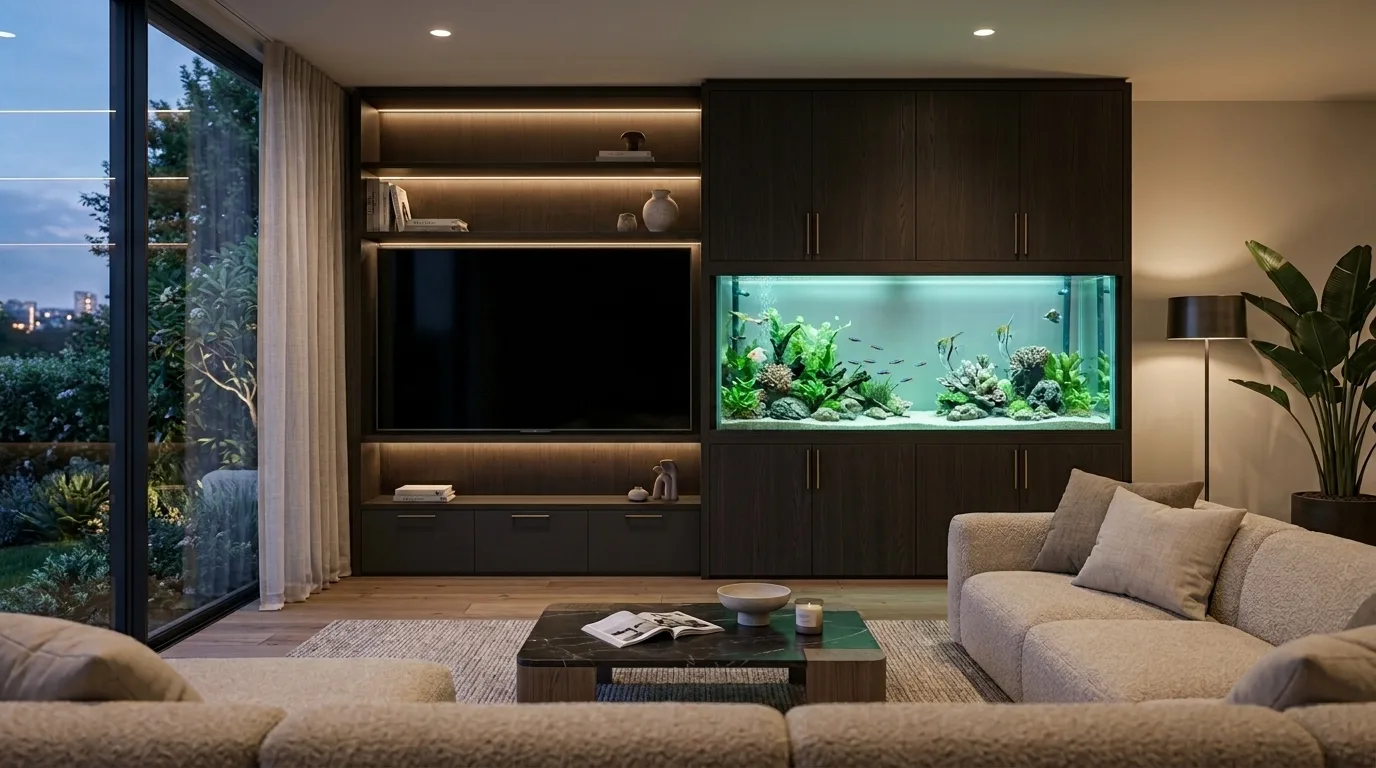
Fish Tank Media Wall
This type of wall only makes sense if the build is designed around servicing from the start. The aquarium needs access for filtration, electrics and cleaning, so the joinery should include a hidden maintenance cupboard or removable panel rather than treating the tank as a sealed display box. Moisture-resistant MDF, aluminium vent grills and low-voltage lighting are sensible specifications in this setup because condensation is a real consideration, not a styling note. It is a striking feature. But it is also a technical one.
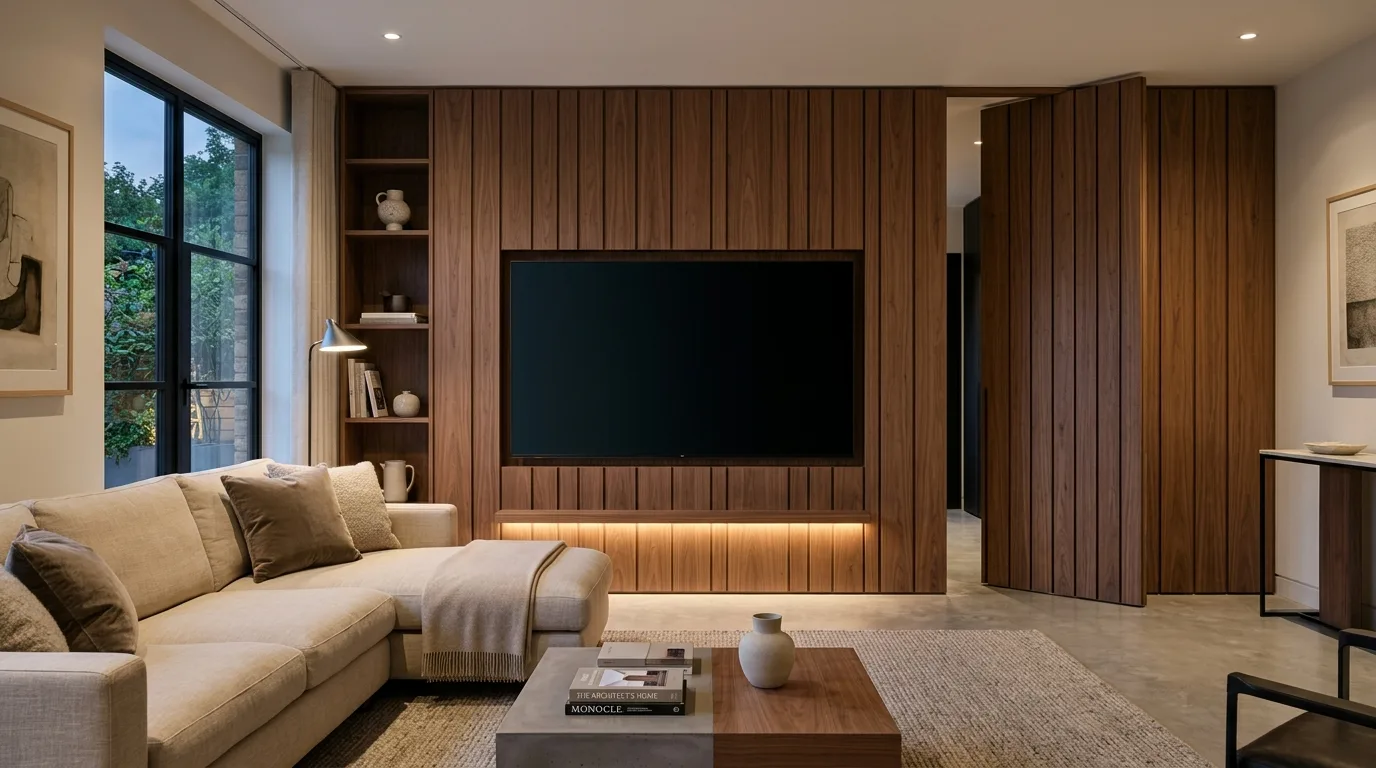
Hidden Door Media Wall
Sometimes the room has an awkward requirement behind the feature wall such as storage, a utility area or a secondary room that the design should not advertise. That is where a concealed door becomes useful. The cleanest versions usually rely on a push-to-open system, full-height panelling and a scribed door leaf with a consistent 3 mm perimeter gap, so the opening disappears into the wider composition. Get the hinge choice right early. A concealed hinge with the wrong opening angle can ruin shelf alignment beside the door.
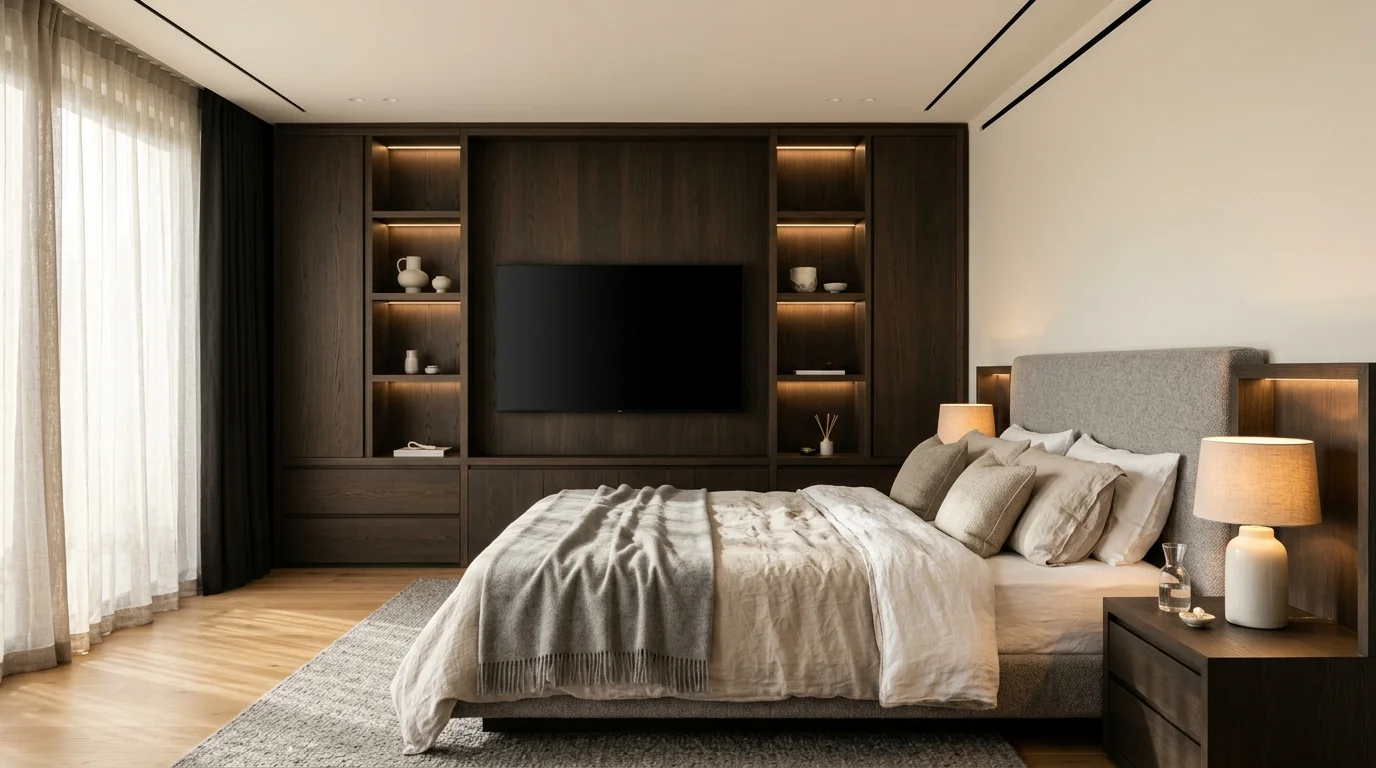
Bedroom Media Wall with Integrated Wardrobes
Bedrooms need this concept to work harder than a lounge wall because the storage pressure is higher and the visual tolerance is lower. One run might need to hold a television, hanging space, drawers, bedside niches and charging points without making the room look over-fitted. Warm oak interiors, upholstered headboard panels and handleless wardrobe fronts can help the larger unit read as furniture rather than a line of cupboards. Ceiling height matters here. Below about 2.35 metres, full-height overhead bridging units can start to feel oppressive unless the palette is kept very light.
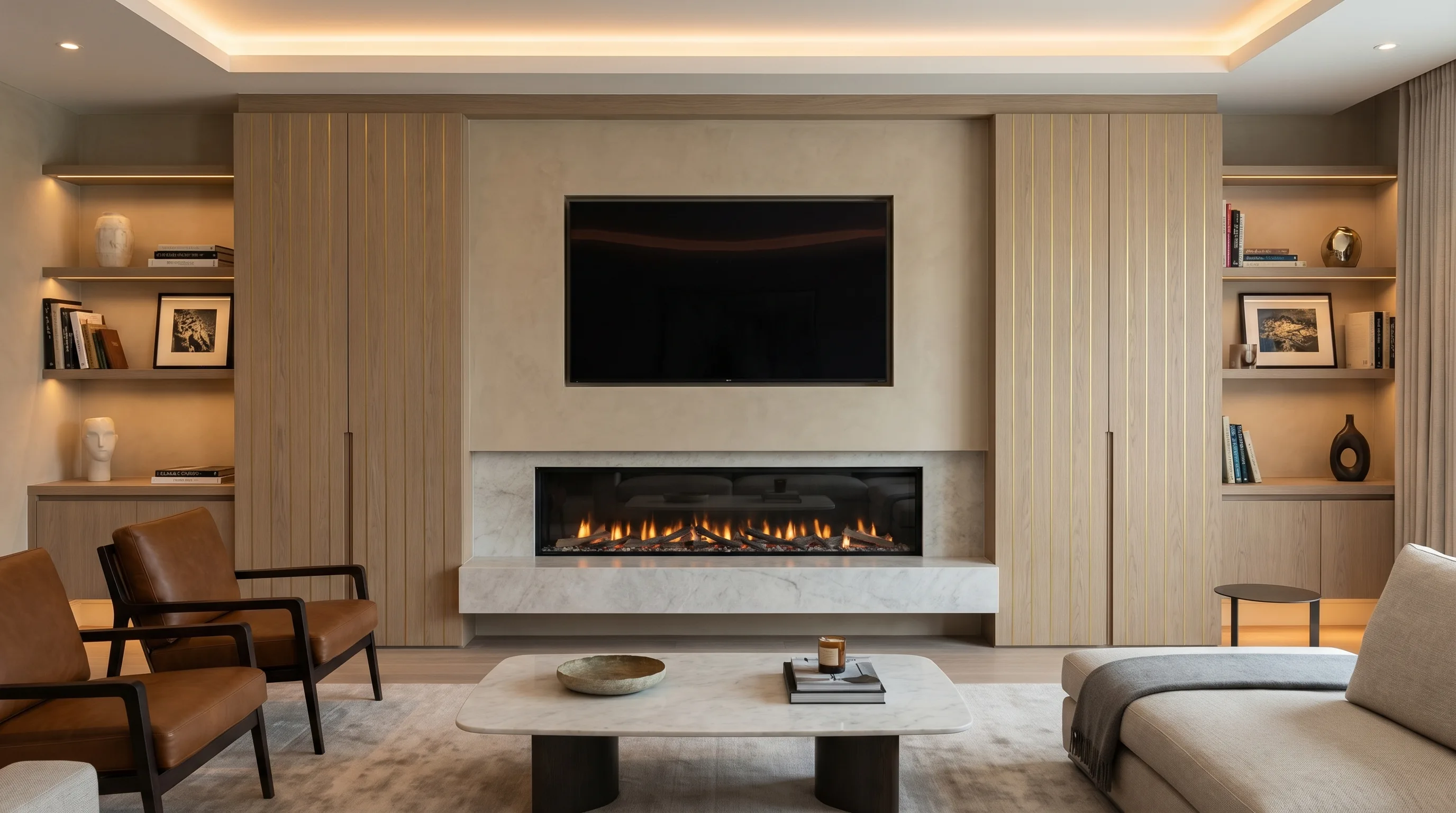
Library or Bookshelf Media Wall
This idea suits rooms where the television should sit inside a broader composition rather than dominate it. Books, objects and closed storage break up the black screen, but the shelving needs proper depth to be useful. Around 250 mm is a practical starting point for books, while deeper sections can be reserved for larger pieces or integrated speakers. Dark-stained oak works well because it gives the shelves presence even when they are not heavily styled. Done with restraint, this is one of the few media wall formats that can feel both decorative and functional.
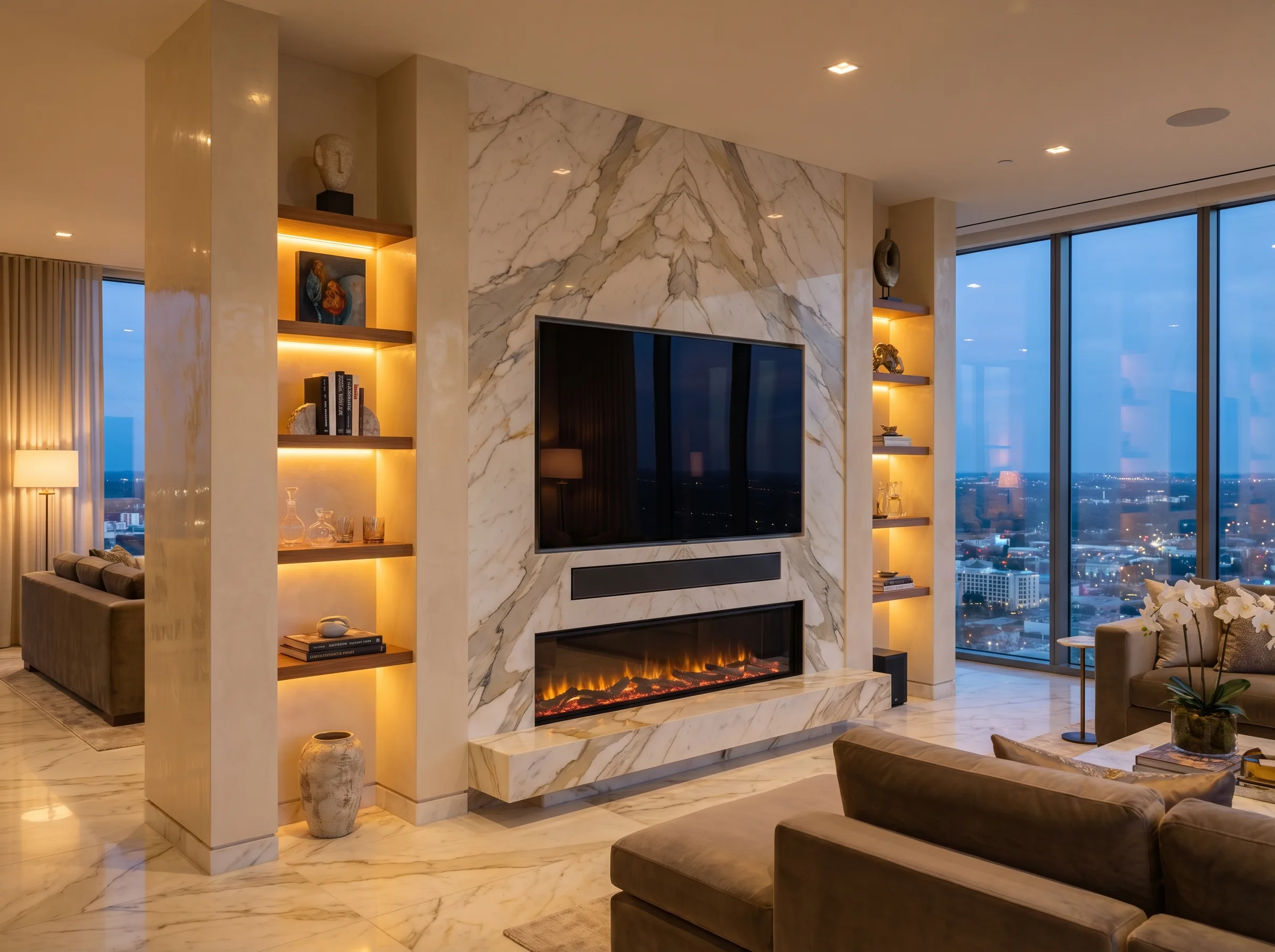
Media Wall as a Room Divider
Open-plan kitchens and living spaces often lose their definition once the dividing wall comes out, and a double-sided media wall can put that structure back without closing the room off again. Because the unit usually stands away from the surrounding walls rather than fixing to one, it needs a proper connection to the ceiling or floor to carry its own weight, and that has to be agreed before any cabinetry gets drawn. Fluted oak or slatted timber on both faces lets light move through the divider instead of blocking it outright. Allow at least 400mm depth if both sides carry cabinetry rather than a single slim TV recess. Get the structural fixing settled first. Everything else is easier once that's in place.
The strongest media wall concepts usually come from solving a room problem first, then choosing materials that support that decision. Our media wall storage guide explains how we choose between shelves, drawers and concealed compartments. Once the layout and technical constraints are right, the finish has a reason to be there instead of just filling space.
Media Wall FAQs
Questions we hear most often from clients at the early stages of planning.
Ask a questionA bespoke media wall starts from £7,000. This covers custom cabinetry built to your room dimensions, concealed cabling and LED lighting. A full-width floor-to-ceiling installation with integrated fireplace typically ranges from £10,000 to £20,000 depending on size and materials. All quotes are fixed price with no hidden costs.
Floor-to-ceiling builds with integrated cabinetry are consistently the most requested. The full-height installation eliminates the gap above lower units that makes them read as furniture rather than architecture. Fluted oak panelling combined with a central TV recess is currently one of the most requested treatments we receive.
The most requested finishes are warm white, smoked oak, navy blue and anthracite grey. Warm white is the safest choice in a room with limited natural light. Dark finishes work well in rooms with high ceilings where you want the wall to read as a deliberate design choice. Colour is always finalised at consultation in context of the floor, the light and the existing furnishings.
Yes. An electric or bio-ethanol fire can be integrated into most media wall builds. The fire unit sits in a recessed aperture below the television with the surround built flush to the wall face. Gas fires require a gas safe engineer and flue provision, assessed at consultation stage. A media wall with integrated fireplace typically adds £2,000 to £5,000 to the base build cost depending on the fire specification.
A standard installation takes three to five days on site. A larger build with stone panelling or a fireplace typically takes five to seven days. We work with our own team throughout with no subcontractors, which means the schedule given at the start is the schedule we keep. Cable concealment, lighting and equipment placement are all completed as part of the build.
The primary structure is moisture-resistant MDF or plywood with a finished face in your chosen material. Options include painted MDF, solid oak or walnut veneered board, lacquered panels, or stone and porcelain for the central feature section. We do not use flat-pack carcasses or imported box systems. Each build is fabricated specifically for your room and its fixed dimensions.
Yes, and it is increasingly common. A bedroom media wall typically combines a television recess with flanking storage or display shelving. The depth is slightly reduced compared to a living room build to keep the room from feeling enclosed. A dark finish such as smoked oak works particularly well in a bedroom context, creating a headboard-and-storage-wall in one piece.
In most cases no. Media walls are built against standard partition or solid walls in existing rooms. We frame out from the wall surface to create the depth needed for cabinetry, cabling and any fireplace recess. The build adds typically 100mm to 350mm of depth depending on the design. We assess the wall construction at consultation stage.
Where to Start
If you are at the early stages, collecting references and considering whether a media wall is the right choice, the most useful next step is a design consultation. We visit, take measurements, look at the room in context and give you an honest view of what will work and what will not.
There is no charge for the consultation and no obligation to proceed. It is the point where inspiration becomes a project.
Book a ConsultationMedia wall inspiration
Bespoke projects, distinctive finishes and ideas for your space. Occasionally, by email.